
“As computer technology becomes part of everyday life, a new program comes to BBC2 now: be you beginner, buff, or somewhere in between.”
Thanks to Martin Brewer, here’s the first episode of The Net, a documentary series that ran for four seasons from 1994 to 1998. Despite the name, this first episode has very little to do with the Internet. Instead, it’s an almost perfect video equivalent of the early Wired Magazine, covering a mish-mash of digital culture from video games to virtual reality.
This episode has five segments.
1. Neo-Nazi BBSes (0:50)
 “Every year on April 20, Germany’s growing number of neo-Nazis try to celebrate the anniversary of Hitler’s birthday and every year, the German authorities try and stop them. Up until recently, the intelligence services have managed to limit the activities of the far right by monitoring their phone calls and intercepting their mail. But now the German government has a big problem: the fascists have gone high-tech.”
Journalist Rajan Datar covers how German extremist groups were organizing using electronic mail and computer networks in the mid-1990s. He interviews the head of German secret service Ernst Uhrlau, journalist Clemens Hoeges (now with Der Spiegel), and Wolfgang Henning, who was instrumental in setting up Thule-Net, one of Germany’s largest networks. An anti-fascist hacker named Rolf Wurdemann shows Datar how to sign in to Widerstand (“Resistance”) BBS, discussing how they can retrieve confidential materials or “crash the system.”
Eduard Lintner, the Parliamentary Secretary of State, discusses potential legislation to limit the use of computers by far left and far right groups. Rena Tangens from the Bionic Computer Club provides the best quotes in the segment. “I think it’s greatly exaggerated media hype, used by politicians to suppress the free communication that’s possible in free networks.” “If you want freedom, you have to accept that people use and even abuse the freedom. If you have a society that’s strong enough and has enough common sense, it’s no problem.”
Some of the imagery in the segment is completely over-the-top, like the swastika 3.5″ floppy inserted into a Mac Classic, barb-wire wrapped PC, and a stormtrooper boot stomping down in front of a monitor. The shots of the Neo-Nazi BBS login screens are interesting, though, including a glimpse of who was signed in at the time.
2. Thomas Dolby on Game Audio (8:10)
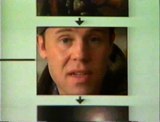 “Video games and virtual reality usually allow us to escape to somewhere a little bit more glamorous than a kitchen, and yet their music is usually so irritating that I end up turning it off altogether. But I started thinking about how the objects and spaces in my everyday life generate their own soundtrack. And I began to wonder whether could maybe take the objects and spaces, goals and treasures in a computer game, and write a computer program that would allow me to attach musical events to those actions within the game.”
Thomas Dolby takes us into his home to talk about his approach to dynamic audio design in gaming. He walks through a sample game for the Mac that uses mouse events to trigger and adjust audio samples in real-time. Gameplay footage of Aero the Acro-Bat (SNES) and Corey Haim in Double Switch (Sega CD), for which Dolby did the soundtrack.
3. Net Attack by Jules (15:25)
Pure filler, a young girl gives a very short review of Super Mario Land 3 for the original Gameboy. This segment was cut after the first few episodes. She gives it a 7/10. Jules Gibbons: If you’re out there, get in touch! What are you up to now?
4. How to Connect to the Internet (17:40)
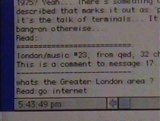 “We call this series ‘The Net’ because the real future of computers lies in telecommunications. Computers can communicate over small local networks and giant nets the span the globe. The network-of-networks is called the Internet, one of the fastest-growing means of communication in the world. One of Britain’s most experienced ‘net surfers’ is Davey Winder, and he’s also one of the best guides around the Internet.”
Susan Rae talks to Davey Winder, a computer geek decked in cyberpunk regalia with long hair, piercings, and leather vest. Winder walks her through the process of dialing into CIX and Compuserv on the Mac with a 14.4 modem. Some great shots of Gopher and the early web with NCSA Mosaic. Screenshots of the email app show that they’re surfing the web as it looked on March 28, 1994.
5. Virtuality (22:55)
 “It may seem surprising, but the current world leader in virtual reality games is a British company called Virtuality, based near Leicester. With VR entertainment set to become a multimillion dollar market, Virtuality is facing stiff competition from the Japanese and American games giants. But despite recent losses, Virtuality’s founder 34-year-old Jonathan Waldern is confident the company can survive.”
Some outstanding footage of a Wii Boxing ancestor, Virtuality Boxing, with its early 3D graphics, clipping problems, and horrendous framerates. Some great shots of other Virtuality press materials and concept art from Hunter Zone.
Industry analyst Barrie Sherman runs through the laundry list that would eventually lead to Virtuality’s bankruptcy. “I think the present virtual reality games are very rudimentary. The graphics aren’t very brilliant, the lag times are very difficult, the actual games themselves and quality of the games when compared to other computer games just aren’t very good. I think it’s getting by on novelty and hype, for the moment.”
Jonathan Waldern’s best quote is delivered with a smile, “What’s the company worth today? I looked in my newspaper this morning and it’s apparently worth $92 million.”
Net Cetera (28:12)
One cute feature of this show was “Net Cetera,” a big text dump displayed after the end credits, designed to be recorded on a VCR and rewatched in slow motion. Very quickly, they list all the referenced phone numbers, URLs, and more detailed information about each segment.
As always, the full MP4 source video can be downloaded from Blip.tv.
I just remembered watching this show live when it was on TV. Total Deja-vu experience!
Total Deja-vu experience!
I just watched that episode with interest. I haven’t seen that footage of Virtuality before! Brings back fond memories of working there. 🙂
I used to work at Virtuality until it’s untimely demise! I say untimely, as things were getting a lot better in the latter years. However, it was too late. Too many mistakes were made prior to that and it was always a struggle to keep the company afloat. A number of games under development never saw the light of day, which was a real shame.
The company eventually went into Administration in 1997. However, it still kind of lives on until this day as the company was split up… Cybermind took the hardware division, and I co-founded a Serious Games company called Maelstrom, which is still around today 🙂
Wow, that’s a flashback. That music. I was also of the age then to really fancy Jules.
Now it does look terribly dated with all of the deliberate way of describing everything, anunciating the jargon etc. I can’t help thinking though that it has much the same magazine format as ‘Click’ the BBC’s current show about the web and technology.
http://news.bbc.co.uk/1/hi/programmes/click_online/default.stm
I loved the net when it was broadcast and I would say that it certainly helped to introduce me to the concepts of the internet, even if it would be at least another four years before I bought my first dial-up modem.
One of the announcements inside is history in the making. The BBC Bulletin Board that went on air after the broadcast of the programme was I think the first web presence and the ancestor of bbc.co.uk.
Ha! Superb.
I’d completely forgotten about this. Even reading your synopsis before watching I still didn’t think I’d seen it. But then the memories cam flooding back! Set your VHS recorder, hilarious.
1994 was the year I started my University course in Art & Technology (MediaLab Arts). I didn’t create my first web page until 96, one page with anchor links, state of the art then 🙂 The overview on how the net works was pretty much how our lecturers explained it as well!
Thanks for posting, it’s great to see how much has changed in 14 years
I was Jules Gibbons who presented “Net Attack”. Half my lifetime ago! I was 14 then. After the first series of The Net they dropped Net Attack as they felt it didn’t fit into the serious style of the rest of the show. After that I worked on a kids Saturday morning show called Scratchy and Co (ITV) for a while reviewing video games again. It was fun as a child to be involved in TV but I wouldn’t like to do it now. I’m now a dance teacher, married with three kids! Glad someone remembers me, haha.
OMG it’s JULES! I loved you when I was about thirteen and my friends and I would always talk about how surreal and amazing NET ATTACK was the next day. Brilliant!
Oh wow, Jules… Really glad you found this. I’ve got to ask, did you actually live in Glastonbury, or was that picked as a ad-hoc sort of place to film a game review? Everything looks so Somerset…
Jules, married, my heart sinks. At the time I really liked your slot. Anyway found a clip of Kate Russel (Click online) as you have never seen here before :- http://www.youtube.com/watch?v=Qn7WDfIAyQg&feature=related
Wow its a gem.
I worked at Virtuality as well – and co-founded Cybermind when Virtuality went bust – we have since become EducationCity.com, http://www.educationcity.com and we are now used in over 12,000 schools across the globe – so sometimes there is a happy ending, although it has taken 13 years!
Im looking for other ’94 episodes of this, because I was 17 when I was on it, and Im trying to explain to my kids just how revolutionary the internet was to me at an age like that!