Ello launched on August 7, 2014 with big dreams and big promises, a new social network defined by what it wouldn’t do.
They laid it all out in a manifesto, right on their homepage:
Your social network is owned by advertisers.
Every post you share, every friend you make and every link you follow is tracked, recorded and converted into data. Advertisers buy your data so they can show you more ads. You are the product that’s bought and sold.
We believe there is a better way. We believe in audacity. We believe in beauty, simplicity and transparency. We believe that the people who make things and the people who use them should be in partnership.
We believe a social network can be a tool for empowerment. Not a tool to deceive, coerce and manipulate — but a place to connect, create and celebrate life.
You are not a product.
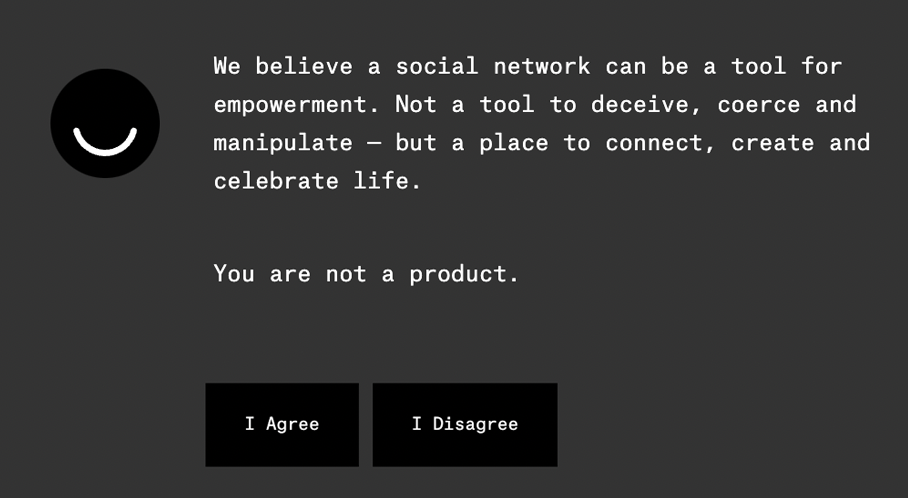
From its launch, Ello defined itself as an alternative to ad-driven social networks like Twitter and Facebook. “You are not a product.” (The “I Disagree” button linked to Facebook’s privacy page.)
I’d link to that manifesto on Ello’s site, but I can’t, because Ello is dead.
In June 2023, the servers just started returning errors, making nine years of member contributions inaccessible, apparently forever — every post, artwork, song, portfolio, and the community built there was gone in an instant.
How did this happen? What happened between the idealistic manifesto above and the sudden shutdown?
It’s a story so old and familiar, I predicted it shortly after Ello launched.
Ello’s Funding and Launch
Ello, for those who don’t remember, described itself as a “simple, beautiful, and ad-free social network created by a small group of artists and designers.” It launched with a distinctly minimalist monochrome interface and an even more minimalist set of features.
Like Diaspora and App.net before it, Ello partly defined itself by its opposition to the exploitive business models and content moderation practices of major social networks, so quickly found itself deluged by people fleeing Facebook and dubbed by media outlets as an “anti-Facebook” or “Facebook killer,” something the Ello team never intended it to be. It was an uncomfortable balancing act, but they leaned into the publicity, at least for a while.
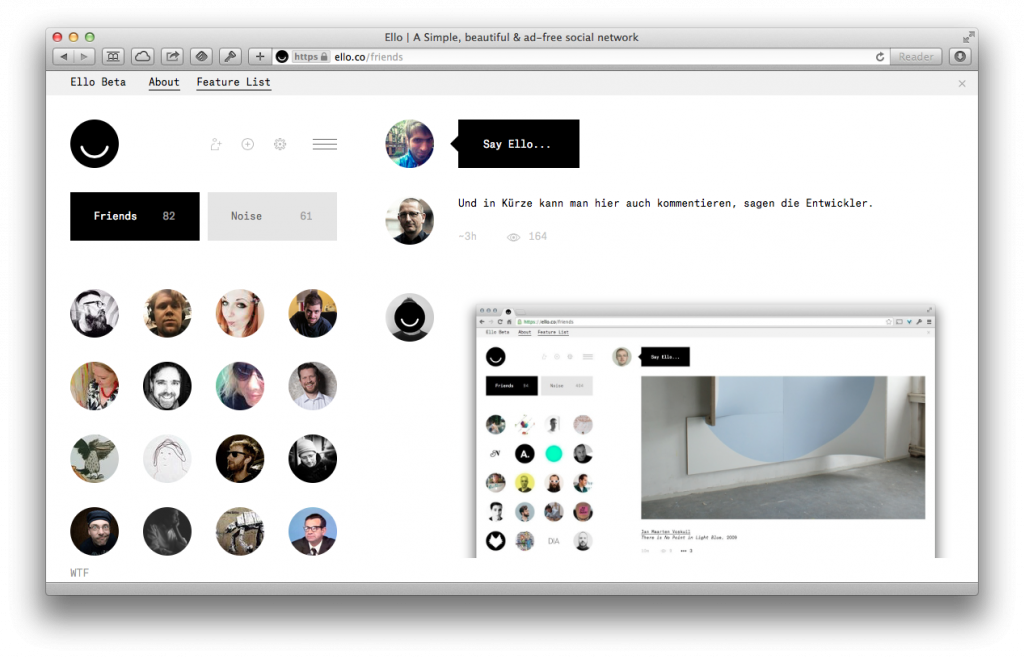
In September 2014, one month after it opened its invite-only beta, I wrote a post about Ello on Ello.
Digging through SEC filings, I discovered that the newly-launched indie social network had taken nearly half a million in seed funding from a venture capital firm, which seemed counter to its indie manifesto. Since nobody else mentioned the funding, including Ello themselves, I wrote about it.
Here’s what I wrote:
Building something like Ello costs money. They have a team of at least seven people, and have worked on it for months. That doesn’t come cheap.
The About section makes it seem like Ello was built independently, a group of artists making something for themselves, presumably funded by volunteer effort and maybe a seed investment from Ello president and CEO Paul Budnitz, who also founded Kidrobot and Budnitz Bicycles.
But a little digging shows a much more predictable source: they took a $435,000 round of seed funding in January from FreshTracks Capital, a Vermont-based VC firm that announced the deal in March.
Why is this a problem?
The Ello founders are positioning it as an alternative to other social networks — they won’t sell your data or show you ads. “You are not the product.”
If they were independently-funded and run as some sort of co-op, bootstrapped until profitable, maybe that’s plausible. Hard, but possible.
But VCs don’t give money out of goodwill, and taking VC funding — even seed funding — creates outside pressures that shape the inevitable direction of a company.
Before they opened their doors, Ello became hooked on an unsustainable funding model — taking cash from VCs — and will almost certainly take a much larger Series A round once that $435,000 dries up. (Which, at their current burn rate, should be in a couple months.)
And they’ll have no trouble getting it. There’s a lot of money out there right now, and it will be extremely tempting to take it, especially if refusing it would mean closure or layoffs.
The problem, of course, is that VCs aren’t like Kickstarter backers, or even like angel investors. Kickstarter or Patreon backers just want the thing being made. Angel investors may have other reasons to invest beyond equity: fame, insider access, or maybe just the joy of helping something exist.
VCs may invest in things they think are interesting or want to exist, but they primarily invest money in startups to get a return on their investment, on behalf of their limited partners. That return usually takes the form of an exit: an acquisition or an IPO.
Unless they have a very unique relationship with their investors, Ello will inevitably be pushed towards profitability and an exit, even if it compromises their current values. Sometimes, this push comes subtly in the form of advice and questions in emails, phone calls, and chats over coffee. Sometimes, as more direct pressure from the board. (FreshTracks’ Managing Director sits on their board.) Or, if things go bad, by replacing the founders.
The Ello team knows that how a startup is funded shapes how it behaves. They spend a good chunk of their About pages talking about how they’re not going to make money (not ads or selling your data), and a little bit about how they hope to (paid premium features). I hope they’re right — it’d be great to have more startups that aren’t reliant on ads.
But they completely fail to disclose how Ello is being funded now, which matters just as much, if not more, as any future revenue plans.
I love seeing people build new stuff. More people trying to build crazy experimental communities on the Internet is a very good thing. And nothing’s more audacious than trying to build a new social network.
Social networks become the glue that connect people together — the foundation for friendships, relationships, and new works of creative expression.
Building a social network is like opening the doors to a huge party and inviting everyone in. Without a way to get your stuff out, shutting down a social network is like locking the door and burning the place down.
At the moment, Ello is a free, closed-source social network, with no export tools or an API, fueled by venture capital and a loose plan for paid premium features. I think it’s fair to be skeptical.
Like everyone else here, I hope Ello can stick to their principles, resist outside pressure, fight market forces, and find a unique and sustainable niche.
Let’s hope their investors feel the same way.
The Founders Respond
That post quickly blew up on Ello, and then went far beyond it, with coverage in articles from The Verge, The Guardian, VICE, The Atlantic, and Business Insider, among others.
Ello’s CEO, co-founders, and investors dismissed the concerns I raised, starting with co-founder and CEO Paul Budnitz, who told Betabeat it was “silly.”
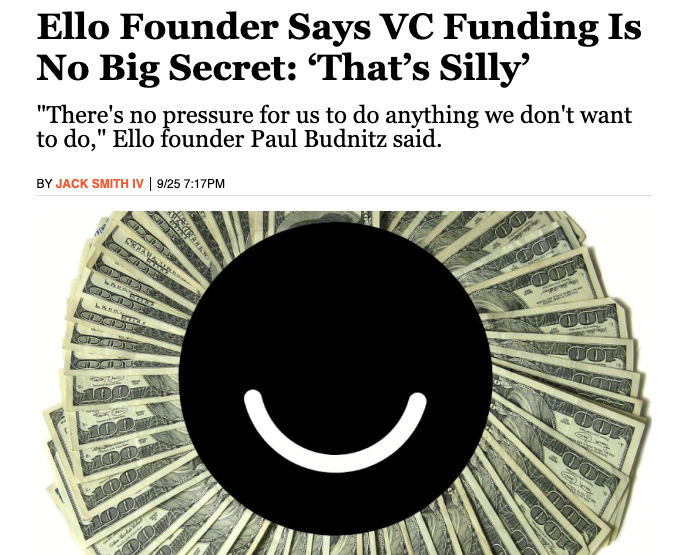
“In fact, Ello is controlled executively by its 7 founders, who own a majority share in the company,” wrote Betabeat’s Jack Smith IV. “They say that the cynical claim that they’ll sell out eventually, or that anyone can tell them what to do, is ridiculous.”
Co-founder Todd Berger laughed at a GigaOm writer who asked him about my post. “There’s seven founders and we own 82 to 84 percent of the company, so we can do whatever the hell we want,” Berger said.
“We’re not going to sell out our soul to grow our company,” continued Berger. “Maybe it’s hard to believe.”
I followed up with a second Ello post:
I’ve received a dozen emails in the last day and a half from journalists looking for quotes about Ello. I didn’t reply to any of them. I have no interest in being the anti-Ello poster boy, for one main reason:
I think Ello’s pretty neat, and I want them to succeed.
Like I said in my post, more experimentation with online communities is a very good thing. We’ll only break away from the dominant players by trying new crazy shit, and I think it should be applauded. (And, yes, I even like the design.)
But I think taking VC was a bad idea that works against their ethos, and will inevitably lead to a much larger Series A by year’s end.
I think the intentions of the team are pure, and they genuinely believe in what they’re building. But I’m not sure intentions matter unless they can wean themselves off outside funding.
I really, really hope their revenue plan works out, and quickly.
Series A and the PBC
One month later, Ello announced they’d raised significantly more money: a $5.5 million Series A round co-led by TechStars and Foundry Group, who took a board seat, with participation from FreshTracks Capital, who already sat on the board.
Coinciding with this funding, and perhaps anticipating the backlash, Ello also announced they had converted the company to a Public Benefit Corporation.
In a public letter signed by their founders and investors, they wrote:
There has been some speculation in the press since our launch that Ello will someday be forced to allow paid ads on our social network.
With virtually everybody else relying on ads to make money, some members of the tech elite are finding it hard to imagine there is a better way.
But 2014 is not 2004, and the world has changed.
Effectively, Ello would be a for-profit corporation required to pursue social good as part of its charter, instead of solely maximizing shareholder value. Unlike a B Corp certification, this would enshrine their values in their legal structure, which is a pretty big deal. They were the most notable technology company to form as a PBC until that point, preceding Kickstarter’s conversion by nearly a year.
A dedicated page on their site explained the significance of the PBC, and the charter they were now bound by:
To assure that Ello always remains ad-free, Ello converted to a Public Benefit Corporation (PBC). A Benefit Corporation is a new kind of for-profit company in the USA that exists to produce a benefit for society as a whole — not just to make money for its investors.
The Ello PBC charter states in the strongest legal terms possible that:
- Ello shall never make money from selling ads;
- Ello shall never make money from selling user data; and
- In the event that Ello is ever sold, the new owners will have to comply by these terms.
Ello exists for the benefit of the creative community, and we will never serve ads or sell personal data.
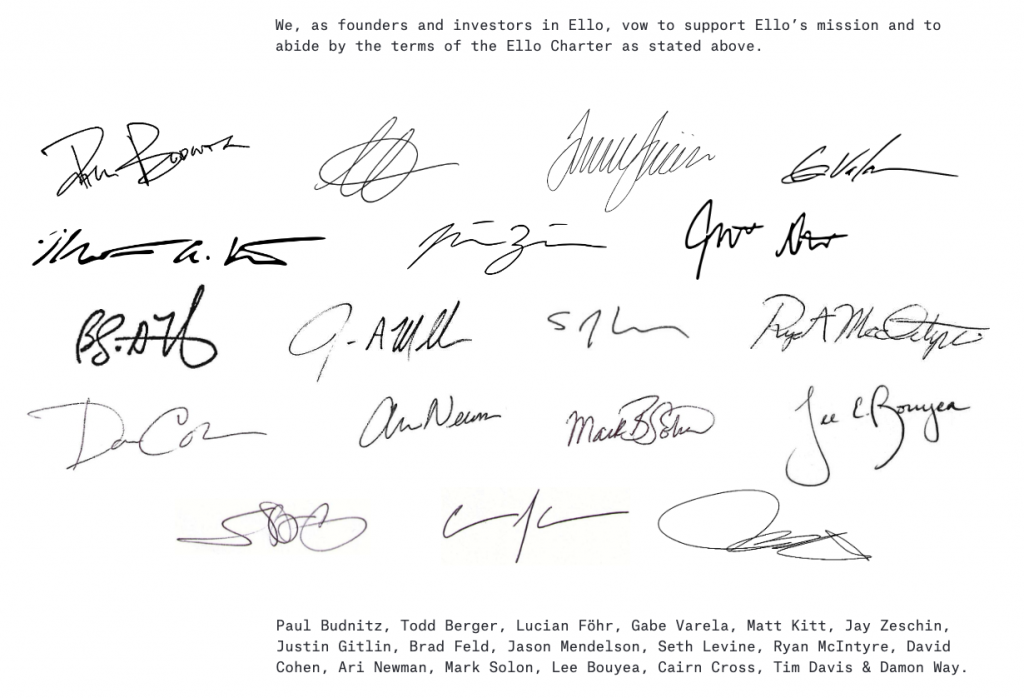
This was a commendable change, though somewhere along the way, all the public debate about raising professional money and profit maximization became solely about switching to a paid advertising model and selling user data. This was a straw man argument that was easier to knock down.
But there are many, many ways for a social network to become worse for their users than running ads.
My concern wasn’t that Ello would start running paid ads. I don’t even mind ads, as long as they’re done thoughtfully and with privacy in mind. (I ran ads from The Deck here for years.)
I was worried that, by taking outside funding, Ello’s values were no longer fully-aligned with the community: they were aligned with their investors. In time, given more money and more pressure, they would be inclined to do something the community, or even the original founders, didn’t want to do.
Series B and CEO Changes
In April 2015, six months after their Series A, Ello took another $5 million in a Series B round from their previous investors, giving a board seat to TechStars, and bringing their total raised to $11M.
Later that year, in December, Budnitz wrote a new post on Ello looking back on their first year and looking ahead to 2016:
This past week I gave a few interviews to online news organizations.
One of the journalists scoffed when I told him that Ello is built on principles we believe in, and that in 2015 we did everything we could to grow slowly. Rather than sell out and make another giant network the world doesn’t need, we decided to take our time to build the beautiful and inspiring place we have today.
I felt sad for the guy. It’s awful going through life never believing in anything.
So in the spirit of the New Year, and because it was clear that this journalist wasn’t going to believe anything I told him anyway, I figured I’d publish a short list of things Ello will never do:
- Diverge from our mission to empower and support creators to inspire one another, and move the world forward.
- Tolerate hate. Ello has many tools, some visible and others not, that help keep this network positive.
- Sell ads or user data to third parties.
- Sell out.
- Suck.
Three months later, in March 2016, Paul Budnitz stepped down as CEO, citing the distance between his home in Vermont and the rest of the team in Boulder. He was replaced by Todd Berger, one of Ello’s co-founders and lead designers.
Under Berger, Ello refocused its efforts on artists and creators. From a May 2016 press release:
In recent months Ello has doubled down on its mission to support creators everywhere, becoming the premiere community for the world’s leading edge and contemporary artists, photographers, designers, illustrators, architects and GIF makers to share their work and ideas, connect with others, and build organic reach.
In a September 2016 interview with Wired, he said that was what Ello was always meant to be:
Berger had originally intended Ello to cater to artists, but the founding team was split on the idea. “To Paul [Budnitz] it sounded limiting. To our investors it sounded very limiting,” says Berger.
As its new CEO, Berger continued fundraising, but the SEC filing from March 2017 indicates a struggle, raising only $2.5M of the available $4M. In an interview with TechCrunch in November 2017, Berger said he was looking to raise more cash. “We have a lot of investment opportunities coming in from actually some fairly heavy-hitting firms that I hope to close.”
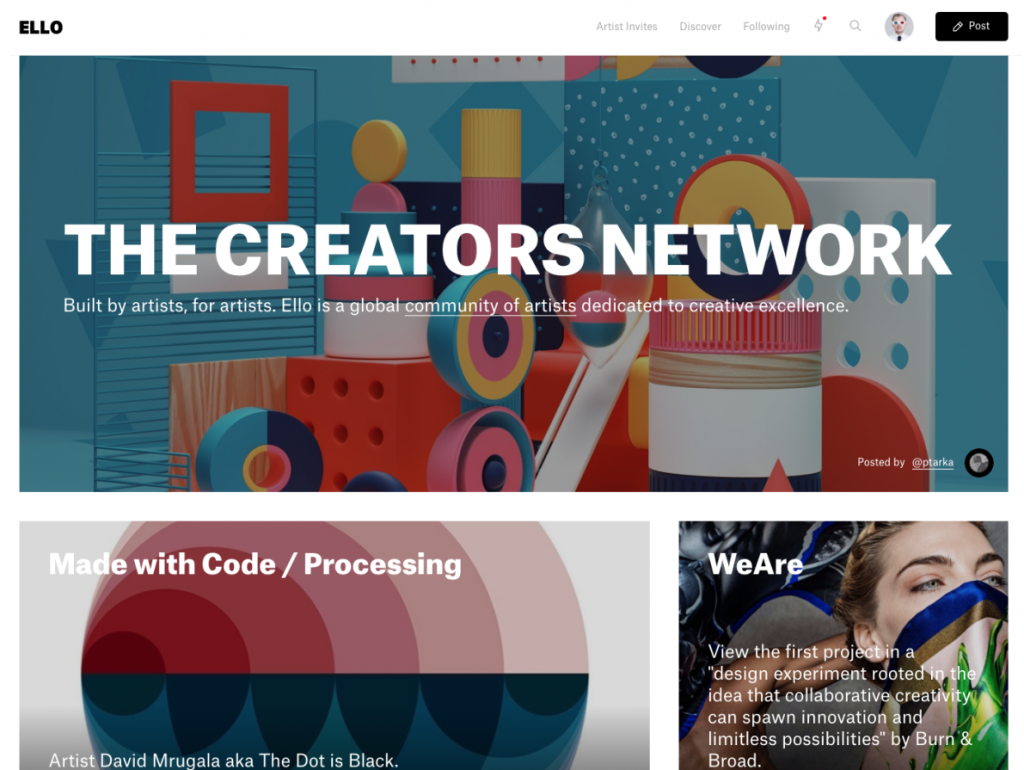
In the same interview, Berger said Ello now had 400,000 monthly active users, with 625,000 artists on the site.
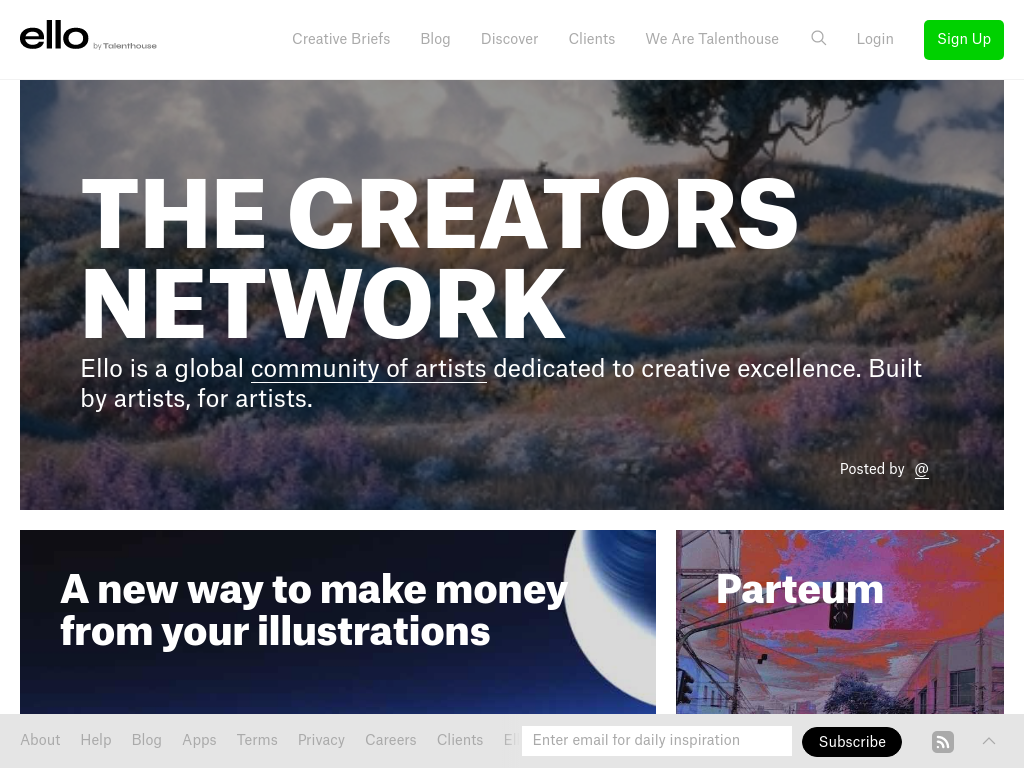
It seemed like Ello finally found its niche as “The Creators Network,” a community of artists and designers using its visual-heavy design to show off their portfolios and promote their work. Their original freemium model never worked out, but sponsored content was handled thoughtfully, with like-minded brands offering giveaways. It was paid advertising, but it didn’t violate privacy or sell user data.
“A lot of people thought we died and went away and the whole time we’ve been cultivating a really niche and creative community that’s gotten more focused as I’ve been able to enact my vision,” Berger said.
The future of Ello seemed bright.
The Acquisition
Five months later, in March 2018, Ello was quietly sold to Talenthouse, a Los Angeles-based company whose primary business was running design contests for brands, in which independent artists competed against each other for a cash prize.
I only know the sale date because it was mentioned in the annual report of a venture capital firm who invested in their Series A. The acquisition was never announced publicly, as far as I can tell, mentioned only in this October 2018 interview with Talenthouse co-founder Maya Bogle, where she said that “earlier this year we acquired Ello.co.”
As an Ello user, I was never notified about the ownership change, even though they sold all my data to an entirely new company. As far as I can find, none of the original founders mentioned the sale publicly when it happened.
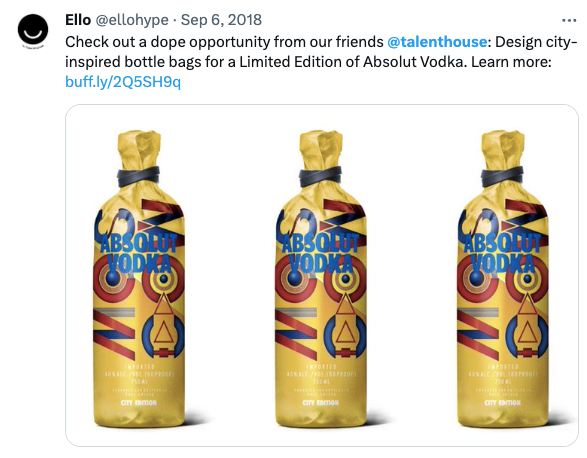
There were telltale signs, though: Ello’s social media started regularly promoting design contests from “our friends at Talenthouse,” while never disclosing the sale. The Ello homepage prominently featured Talenthouse “artist invites” to compete in their design contests from brands like Absolut Vodka, Amazon Prime, Pabst Blue Ribbon, Adidas, and Miller Lite.
The Founders Leave
The following month, in September 2018, the remaining two of Ello’s original remaining co-founders announced they had left the company.
In a cryptic post on Ello and Instagram, Ello’s then-CEO Todd Berger and fellow co-founder Lucian Föhr wrote:
Over the course of the past years we did our best to steer Ello per our vision, always with the intent of putting artists first. At times we succeeded, often we failed. Which brings us to today. We’re no longer at Ello, we can’t elaborate as to why, but it’s time for us to move on and return to studio life.…
If we let you down along the way, we’re sorry. If we didn’t, all the better.
On a July 2019 podcast, Berger and Föhr spoke candidly about their time at Ello, when Berger took over CEO duties and Föhr became the Chief Product Officer.
Todd Berger: The beginning of it was super exciting, super pure, 100% authentic. We built a lot of digital products, worked with lots of startups. We felt like we knew how to do this. We got a lot of momentum. People were stoked.
And then investors got interested and there was pressure to do all these other things. The CEO at the time [Paul Budnitz] got maybe a little overzealous about making lots and lots of money and turning it into a crazier thing than we ever imagined. And it kind of got out of control real fast.
And then we were just kind of holding on, trying to steer it as best possible back to its original kind of the real place we wanted it to live in. And it was tricky, that fast-paced real startup ecosystem— once there’s VC money in there and there’s a lot of press and there’s a lot of attention and you’re not necessarily meeting expectations per the media, per your investors, etc etc.
As for the acquisition, it doesn’t sound like it was a big payday for the original founders. (As preferred shareholders, VCs are typically paid from an acquisition before founders, employees, or other common stockholders.)
Interviewer: Do you feel that the sale of the company justified the time and effort and blood and sweat?
Berger: No, no. Frankly, it wasn’t a lucrative exit. It was more of a, let’s carry this thing on, someone wants it. And it wasn’t about that for us.
Like, had it been something different, who knows what we’d be doing now? But the experience, by and large, was justified. It just, by the nature of taking money in and building a company and a lot of pressure and responsibility, it went on longer and turned into a bumpier grindier thing I think than we wish it would have.
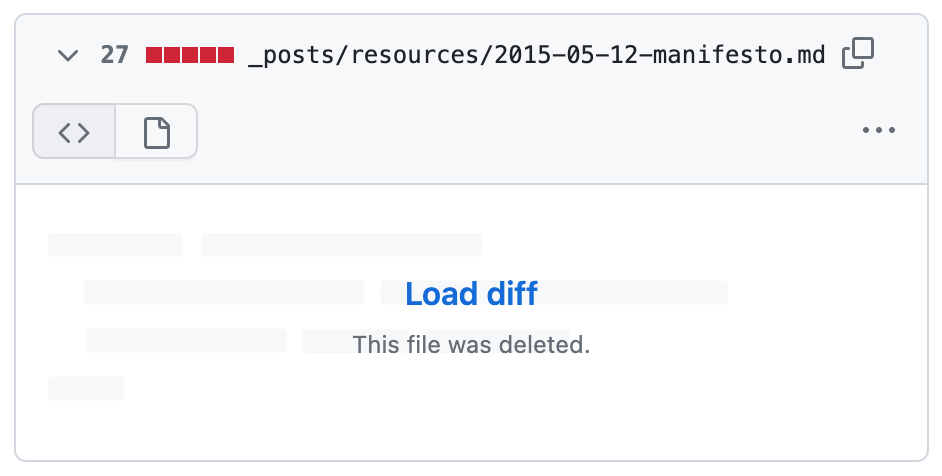
On August 22, 2018, then-CTO Colin Gray deleted the Manifesto, the foundational statement that was part of Ello since before it launched, along with all references to the Public Benefit Corporation and its charter.
Ello PBC was officially dead.
The End
In December 2019, Ello, Talenthouse, and Zooppa merged into TLNT Holdings, a new holding company backed by UK private equity firm AEDC Capital. TLNT was then sold to Swiss investment firm New Value AG, which renamed itself, confusingly, to Talenthouse AG.
In December 2021, Ello changed their logo to finally acknowledge what everyone on the site had figured out long ago.
“Our new logo represents our parent company, Talenthouse, who y’all are already familiar with as we cross promote creative briefs on the Talenthouse platform all the time,” they wrote on the official blog. “You’re creative, you understand the way businesses develop.”
Behind the scenes, Talenthouse was struggling financially.
A February 2023 report in The Observer exposed that Talenthouse was withholding funds from artists who won their creative briefs. A month later, The Guardian reported their parent company was “close to failure as debts mount,” with most of their subsidiaries closed and staff laid off.
Talenthouse, whose clients have included Netflix, Coca-Cola, Nike and the UN, is facing legal action by creditors in the UK and is understood to have laid off most of its workforce, with top executives also departing its parent company in recent days.
Its parent company, Talenthouse AG, has also announced the closure of four other subsidiaries saying they cannot afford to pay outstanding bills, including staff wages.
In May 2023, the company released a statement that it was facing a “critical financial situation,” restructuring the company while finding outside investors.
As a result of the upheaval, Ello’s website started seeing significant downtime starting in June 2023, delivering 500 errors on every page for days at a time. It came back online for a few days in July, and then more errors.
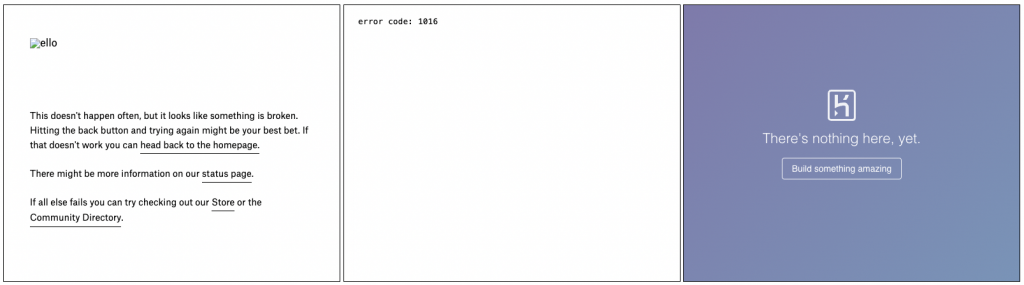
On July 18, 2023, it shut down for good and never recovered. On August 9, the web app was apparently deleted, leaving nothing but a Heroku error.
The Talenthouse corporate site is still online, but the platform is offline, and they haven’t posted anything on social media since January 2023. Ello’s social media team stopped posting in October 2022.
After leaving Ello in 2016, Budnitz returned to his Kidrobot roots with the launch of Superplastic in 2017, a vinyl figure company that expanded into NFTs and the metaverse in 2022, raising a total of $68M in seven rounds of funding, led by Amazon. Superplastic appears to have abandoned its NFT projects last year as the market cratered, and Budnitz stepped down from his CEO role in September, replaced by the former president of blockchain gaming company Dapper Labs. They are now focused on “synthetic celebrities” and AI influencers.
Todd Berger and Lucian Föhr reopened their Boulder design studio, which had shuttered for five years while they worked on Ello. Berger described running Ello as the “low point of my creative career,” so I hope they’re doing better.
As for Ello’s users, they’re out of luck. The shutdown spawned a confused exodus of sorts, former community members trying to figure out what happened on the Ello subreddit, on X/Twitter, on Ello’s last Instagram post, and the comments section of the only other blog post about the shutdown.
“years of my writing down the drain”
“Heartbreaking. I upload my artwork in there and I love the site because it really focused on art.”
“It’s really messed up that there was NO warning to allow us to download our content. That was a very personal space for me and now it’s gone forever? It was my online diary ffs!”
“I had two groups. One had over 18k followers and the other 17k+. No warning at all. Just gone, along with 8 years of content updated a couple of times a week.”
“Did you find a way? It has basically my entire diary :(“
“18k followers and a few years worth of educational posts on fiction writing craft essentials gone.”
Some people tried to contact Ello or Talenthouse directly, but the emails bounced.
Some former members set up a Tumblr group to try to find each other again, “an attempt to maybe preserve and/or recapture what little magic Ello still had for us.”
You Were The Product
From the moment it launched, I liked Ello and wanted it to succeed. Experimentation in social networks is critically important, and there’s enormous value in making new online communities for creative people. I even loved Ello’s minimalist monochrome design, which some people bounced off of.
But from the moment I read about their seed funding, I worried that they wouldn’t be able to build a long-term sustainable business if they were hooked on professional funding and busy chasing growth.
The day after I wrote my first Ello post that blew up, Rose Eveleth published an article in The Atlantic with the blunt headline, “Ello Says You’re Not a Product, But You Are.”
The fact that you, the user, even exist and use their site makes you a product. Ello already has some amount of seed funding from VCs, which means it will need to return to them with something in hand if it wants more. And when it does, or when it is eventually bought by a larger company, you are part of that transaction—a key line in the sales pitch. Your existence on that site is a unit of currency, and it’s a unit that Ello is selling to whoever will give them money for it.
Ello’s founders wrote in their manifesto that, with other social networks, “You are the product that’s bought and sold.” They believed, I’m sure sincerely, that Ello would be different. “We believe that the people who make things and the people who use them should be in partnership. You are not a product.”
Despite their idealist manifesto and their Bill of Rights, I don’t believe they could ever truly be in partnership with their community once they were taking large amounts of venture funding. All of their ideals and big dreams were easily undone, even the legal restrictions they defined in their Public Benefit Corporation charter:
- Ello made money from selling ads to third parties;
- Ello made money selling their user data to a third party;
- Ello was sold, and the new owners didn’t comply with those terms.
In the end, Ello was sold to a third party without notifying its users or giving them the opportunity to opt out of handing over all their content and data, then resold to a new company, and finally shut down and deleted with no notice or recourse.
Would things have been different if they hadn’t taken funding? It’s impossible to say. In all likelihood, it never would have been built in the first place.
But if it had, I doubt it would have ended like this.